16 Jul 2026
Small projects, big opportunities: Why the first step into additive manufacturing is often the hardest

For Australian manufacturers curious about additive manufacturing, the biggest challenge isn’t buying a 3D printer. It’s knowing what to do next.
Desktop printers have become affordable, reliable and remarkably capable. As many of the businesses featured in this series have demonstrated, they’re helping manufacturers prototype faster, test ideas earlier and solve production problems that would once have taken weeks.
But moving beyond prototyping is another matter entirely.
Understanding where additive manufacturing can genuinely improve a product, strengthen a supply chain or create a commercial advantage often requires expertise – and higher-end machines and engineering materials – that many businesses simply don’t have.
Industrial metal printers, advanced polymers, design optimisation software, simulation tools and specialist engineering knowledge remain well beyond the reach of most small and medium-sized manufacturers.
Beyond the desktop printer
Fortunately, much of that capability already exists.
Across Australia, universities have spent years investing in industrial-scale additive manufacturing facilities and developing expertise in design, materials, modelling and manufacturing processes. The challenge has been connecting those capabilities with the businesses that could benefit most.
“Universities typically have substantial capital invested in industry-grade additive manufacturing equipment, providing access to high-end systems for commercially relevant testing and development,” said Dr Matthew Young, Chief Operating Officer of the Additive Manufacturing CRC (AMCRC).
“But it’s more than equipment, “universities can also contribute specialist expertise in design, design optimisation, and numerical modelling, enabling a full development cycle from concept and simulation through to testing and validation for industry partners.”
The missing link
The question is how manufacturers—particularly smaller ones—take advantage of that expertise without committing to a large, expensive research project.
For many, that’s where collaboration breaks down.
Australia’s manufacturing sector is dominated by SMEs, which account for around 95 per cent of manufacturers. While many recognise opportunities to improve products or processes through additive manufacturing, few have the time, internal resources or experience to navigate a university partnership.
“These companies often have a clear understanding of what is needed, they typically have limited capacity and time to initiate and pursue R&D activities”, said Young
“Despite these constraints, there are often clear opportunities for SME’s to apply additive manufacturing to Strengthen supply chain’s resilience, improve product performance, simplify their inventory, and accelerate business outcomes.”
Starting small
Recognising this gap, the AMCRC has introduced the STARTER Project Funding Program, a new initiative designed to lower both the financial and practical barriers to collaborative research.
The program offers matched funding of between $20,000 and $75,000 for projects lasting three to 12 months, allowing manufacturers to collaborate with AMCRC research partners to investigate a specific challenge before committing to larger-scale research.
Rather than expecting businesses to leap into a multi-year collaboration, the aim is to encourage them to start with a manageable project and build confidence from there.
“The other part of research translation and working with universities is a lot of companies haven’t had the chance to develop the relationship or the trust in the university,” Young said.
“That takes time. This provides an opportunity to build those relationships, understand how universities operate, and access their capabilities, from targeted additive manufacturing research to broader areas such as business analysis and transformation that support Additive Manufacturing and AI adoption, at a lower level of risk and investment.”
Building confidence through collaboration
It’s an approach that reflects a common view among experienced research collaborators: don’t start with the biggest project.
One industry adviser describes it simply: “Date before you get married.”
A small, well-defined project allows both partners to understand how they work together before considering a more substantial investment.
If successful, those early collaborations can grow into larger AMCRC CORE Projects, which support multi-year industry-led research with matched funding ranging from $250,000 to $5 million.
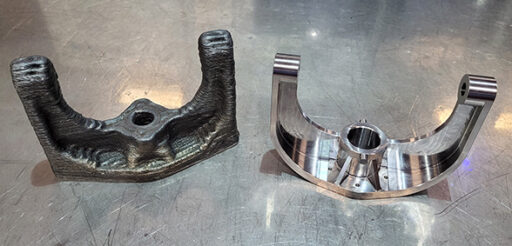
The projects themselves can be surprisingly diverse. Some focus on redesigning existing products for additive manufacturing. Others investigate new materials, improve production processes or identify opportunities to manufacture parts closer to customers, reducing inventory and supply chain risk.
Whatever the application, the objective is the same: helping manufacturers make informed decisions about where additive manufacturing can deliver genuine commercial value.
Creating the next success story
Importantly, the program is also intended to create a growing collection of practical examples.
Each completed project will become a case study, demonstrating how manufacturers have applied additive manufacturing to solve real business problems and providing other businesses with tangible examples to learn from.
“This helps bridge the gap between the knowledge and capability that exists within universities and the number of commercial examples available to industry,” Young said.
For manufacturers still wondering whether additive manufacturing is right for their business, that may prove just as valuable as the funding itself.