21 May 2026
Print Your Profits: What’s holding additive manufacturing back in Australia?

Australia’s additive manufacturing (AM) sector is rich in innovation – but scaling it will require stronger skills, better infrastructure and faster industry adoption.
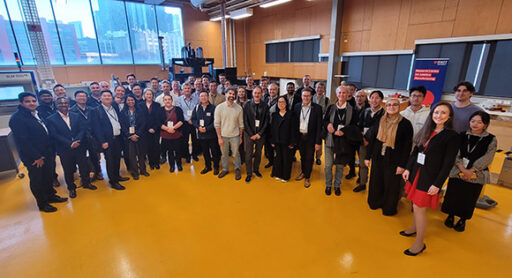
That was the key takeaway from Print Your Profits: Making Money out of Additive Manufacturing in Queensland, a panel discussion hosted by the Australian Additive Manufacturing Network (AAMN) at Australian Manufacturing Week in Brisbane.
Chaired by Boeing Aerostructures Australia Additive Manufacturing Lead and AAMN Chair Matthew Wall, the session brought together leaders from industry, research and government to examine what’s driving – and limiting- AM uptake in Australia.
Adoption is rising — but still behind
While Australia has pockets of global excellence and even world leadership within the nation’s AM community, adoption has been slower than expected.
Much of that slowdown has been structural, linked to decades of offshoring and the loss of local prototyping capability, according to Simon Marriott, Managing Director of the Additive Manufacturing CRC (AMCRC).
However, conditions are now shifting.
“The last five years we’ve seen the cost of printers come down dramatically, the cost of the materials on those printers come down, and the quality and performance of those materials go up,” all of which assisted a “significant increase” in adoption, said Marriott.
“Now we’re starting to see products come out that are 3D printed.”
Lower barriers to entry are enabling more businesses -particularly SMEs – to experiment with the technology, but scaling beyond early adoption remains a key challenge.
More than machines
For companies already deploying AM, success depends on far more than buying a printer.
Dr Toby Maconachie, Additive Manufacturing Engineer at Gold Coast heat exchanger business PWR Advanced Cooling Technology, said while the technology enables complex designs and faster iteration, ecosystem gaps remain.
“You can pretty much model it, slice it and print it — it lowers the barrier to entry,” he said. “But it’s not as simple as just buying a machine when you’re operating at scale.”
PWR is one of Australia’s leading industrial users of metal AM, producing advanced thermal management systems for aerospace, automotive and defence. However, Maconachie highlighted shortfalls in local support industries.
“Recycling powder is a really big thing. In the US and Europe there are better facilities for recycling powder that we don’t really have here in Australia,” he said.
“So we’re losing efficiency because we haven’t hit that critical mass where there’s enough demand for those services to justify investment in them.”
Targeting real value
Panellists agreed additive manufacturing is not a universal solution—success depends on identifying the right applications.
Government programs are helping address this, with matched-funding initiatives through the AMCRC and state programs like Queensland’s Transforming Manufacturing Grants supporting industry trials and adoption.
But investment must be grounded in clear business outcomes.
“It’s not just ‘I want a lathe or I want a 3D printer,’” said Bill Walker, Director of Manufacturing Strategy at the Queensland Government. “They’ve got to be able to demonstrate to us that it’s going to actually… increase their capability and deliver value”.
Skills gap remains critical
Alongside infrastructure, workforce capability remains one of the sector’s biggest constraints.
“Design capability is probably one of the biggest inhibitors to innovation in additive manufacturing,” Marriott said, pointing to a gap in design for additive manufacturing (DfAM).
Engineering fundamentals also remain essential, particularly in areas such as materials performance and structural behaviour.
Professor Stefanie Feih, Director of Griffith University’s Advanced Design and Prototyping Technologies Institute (ADaPT), said the future workforce will need to extend beyond traditional disciplines and draw on skills from established trades.
“There is a lot of transferable expertise,” she said, highlighting strong overlap between welding and metal AM, particularly in areas such as heat effects and material response.
“The two technologies have similar features, including very rapid heating and cooling, we see similar challenges. In welding, this can lead to cracking or embrittlement in and around the weld, and the same effects can occur in additive manufacturing due to residual stresses.”
“So much knowledge can be drawn from practical experience in traditional trades and used to help engineers and technicians transition into operating and understanding additive manufacturing systems,” said Feih.
Collaboration key to scale
The panel also highlighted the importance of collaboration and hands-on learning in building capability.
Wall pointed to Boeing’s approach of pairing engineers with experienced mechanics to bridge the gap between design and production.
“If you design something that’s difficult to manufacture, you experience that directly,” he said.
“That changes how you design.”
From potential to impact
With technology maturing and adoption increasing, the discussion reinforced that Australia’s challenge is no longer proving the value of additive manufacturing – it is scaling it.
The capability exists. The use cases are emerging. The next step is building the skills, infrastructure and industry alignment needed to turn promise into widespread industrial impact.